
Shoreham Village School
The Pioneer Academy
Family of Schools
-

Stewart Fleming Primary School
-

Red Hill Primary School
-

Downe Primary School
-

Southborough Primary School
-

Belvedere Infant School
-

Belvedere Junior School
-

Burnt Oak Junior School
-

Chatsworth Infant School
-

Broadmead Primary School
-

South Norwood Primary School
-
The Crescent Primary School
-

Woodcote Primary School
-

Edenbridge Primary School
-

Halstead Community Primary School
-

Holland Junior School
-
Shoreham Village School
-

Ightham Primary School
-

Moulsecoomb Primary School
-

West Blatchington Primary & Nursery School
-

Hollington Primary School
SEND
SEND
Our Special Needs Co-ordinator is Mrs Becky Bass who can be contacted via the School Office:
office@shoreham.kent.sch.uk or senco@shoreham.kent.sch.uk
Special Educational Needs and Disabilities (SEND)
On 1st September 2014, the Children and Families Act 2014 introduced a new framework for children with special educational needs and disabilities (SEND) representing the biggest shift in SEND for 30 years.
At Shoreham Village School we constantly strive to improve our offer in order to improve the support available to pupils and parents in our school community and provide children with the very best opportunities for future success.
Our School values of being Respect, Responsibility, Determination, Curiosity, Kindness and Courage actively promote diversity across the school.
Zones of Regulation
In September 2024 we introduced The Zones of Regulation as part of our daily practice. This is a programme aimed at developing self -regulation, prosocial skills, self-care and well-being. The coloured zones enable pupils to recognise and learn how they are feeling, sort that feeling into a zone and talk about it if they wish to. Having done this, pupils can then look at the tool box that accompanies each zone. This provides them with a choice of proactive strategies to help them feel calm, happy and ready to learn. (See link for parent information sheet on The Zones of Regulation.)
We are incredibly proud of our inclusive environment that welcomes and aims to support children with a range of learning, social, emotional, communication and physical needs and disabilities.
Identification of SEND
The first step is the identification of SEND using the SEND code of practise.
As such, a child is considered to have a learning difficulty if she or he:
- has a significantly greater difficulty in learning than the majority of others of the same age; or
- has a disability which prevents or hinders them from making use of facilities of a kind generally provided for others of the same age in mainstream schools or mainstream post 16 institutions.
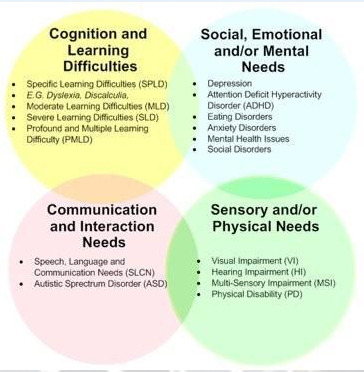
SEND or Special Educational Needs and Disability is when pupils may need additional or different provision to enable them to achieve their potential and is divided into 4 categories that a child will fall into. Areas of Special Educational Need include:
If you have a concern regarding your child, your first port of contact and support is your child’s class teacher.
What happens next?
All the teachers at Shoreham Village School use Quality First Teaching strategies (QFT) looking at the Education Endowment Foundation research regarding creating an inclusive environment for all pupils (poster of findings attached). In addition, teachers use Kent County Council’s Mainstream core standards (parents’ guide in link) in their teaching every day to cater for the needs of all pupils.
We believe in early identification of need and do not need to wait for formal diagnosis to enable children to access the support they need.
We understand and value the role parents play in identifying SEND. We have a graduated approach which includes collating information from our tracking data, pupil participation and progress in interventions, as well as the views of parents, teachers and the child. We will ensure parents are kept informed of our actions.
In addition to this referral process, I hold regular meetings with the class teacher to review the needs of the children they have referred.
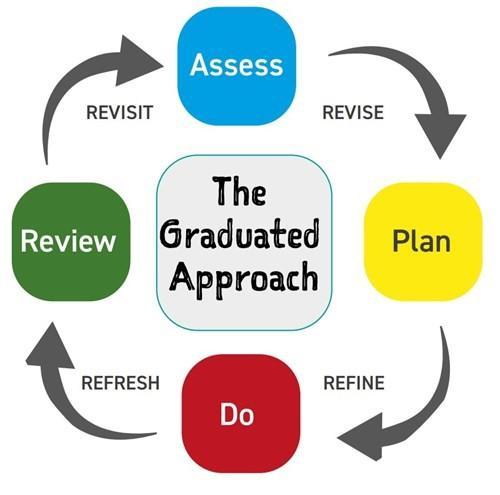
The graduated approach system follows four stages, often referred to as a ‘cycle’: Assess, Plan, Do, and Review.
The four-stage approach is as follows:
- Assess: The class teacher (working with the SENCo) is responsible for carrying out a clear analysis of a pupil’s needs, drawing on teacher assessments and experience of the pupil.
- Plan: Where it is decided to provide a pupil with SEND Support, the parents must be notified. All teachers and support staff who work with a pupil should be made aware of their needs, the outcomes sought, the support provided and any teaching strategies that are required.
- Do: The planned interventions should then be put into place. The class teacher should work closely with any teaching assistants or specialist staff involved and the SENCo will support the class teacher.
- Review: Reviews should take place and inform feed back into the analysis of the child’s needs. The Code of Practice suggests schools should meet with parents three times a year. Good practice would indicate that such reviews will be at regular. The decision to involve specialists can be taken at any time and should always involve parents.
If, despite support being provided in this way, a child or young person is not making expected progress, and requires more support than the notional SEND budgets within the school allow, then Higher Needs funding can be applied for. This could provide extra support from an external agency, additional interventions or additional support in the class. An EHCP may also be required. If a pupil is in receipt of this funding, they will become part of our SEND register (KCC is currently undergoing a SEND review and this funding option is currently changing). Some additional pupils will also become part of our SEND register and not be in receipt of higher needs funding. These pupils will be identified through a rigorous assessment process and be in receipt of appropriate interventions. If a pupil has a diagnosis, they will not necessarily go on the SEND register. It will depend on how much extra support they require.
All staff have high expectations of children and set challenging targets and outcomes. We have clear plans to support children in achieving these goals and provide parents with details of these.
We run a range of specific, targeted and effective interventions but believe that children are best supported by outstanding classroom practice and quality first teaching. We want every child to reach their potential and want to support children and their families in diminishing barriers to achieving.
To see what support there is in the local area for children with SEND, you can go to the ‘ KCC Local Offer’ website that gives SEND children and young people and their families’ information about what support services are available in their area.
https://www.kent.gov.uk/education-and-children/special-educational-needs#local-offer
Our SEND School Policy can be found on the school website on the Policies page. On the Additional Educational Needs Page you will find a list of interventions used to support children with a variety of different academic and social needs.
Please do not hesitate to contact me if you have queries or questions.
Best wishes
Becky Bass
SENCo Shoreham Village School
senco@shoreham.kent.sch.uk
Telephone: 01959522228
SENCO Hours: Monday all day and 8.30am-12.30pm on Wednesdays, Thursdays and Fridays.
Read Kent’s SEND strategy here
